The platform
One screen a day.
Everything else follows from it.
There are only four moving parts: the employee plays, the employee taps a traffic light, HR reads a trend, the employee gets paid in points. This page walks the whole loop — both sides of it — including the parts a demo usually skips.
- Player time2–3 min / day
- Games per weekup to 3
- Programme length4 weeks
- First readable signalmonth 1
Warm, short, and voluntary. Coercion breaks the measurement.
It has to be worth opening.
Otherwise none of the rest is true.
Every design decision on the player side serves one goal: that someone opens this because they want to, not because a manager told them their completion rate is being watched. The moment it becomes compliance theatre, the data becomes theatre too.
The game of the day
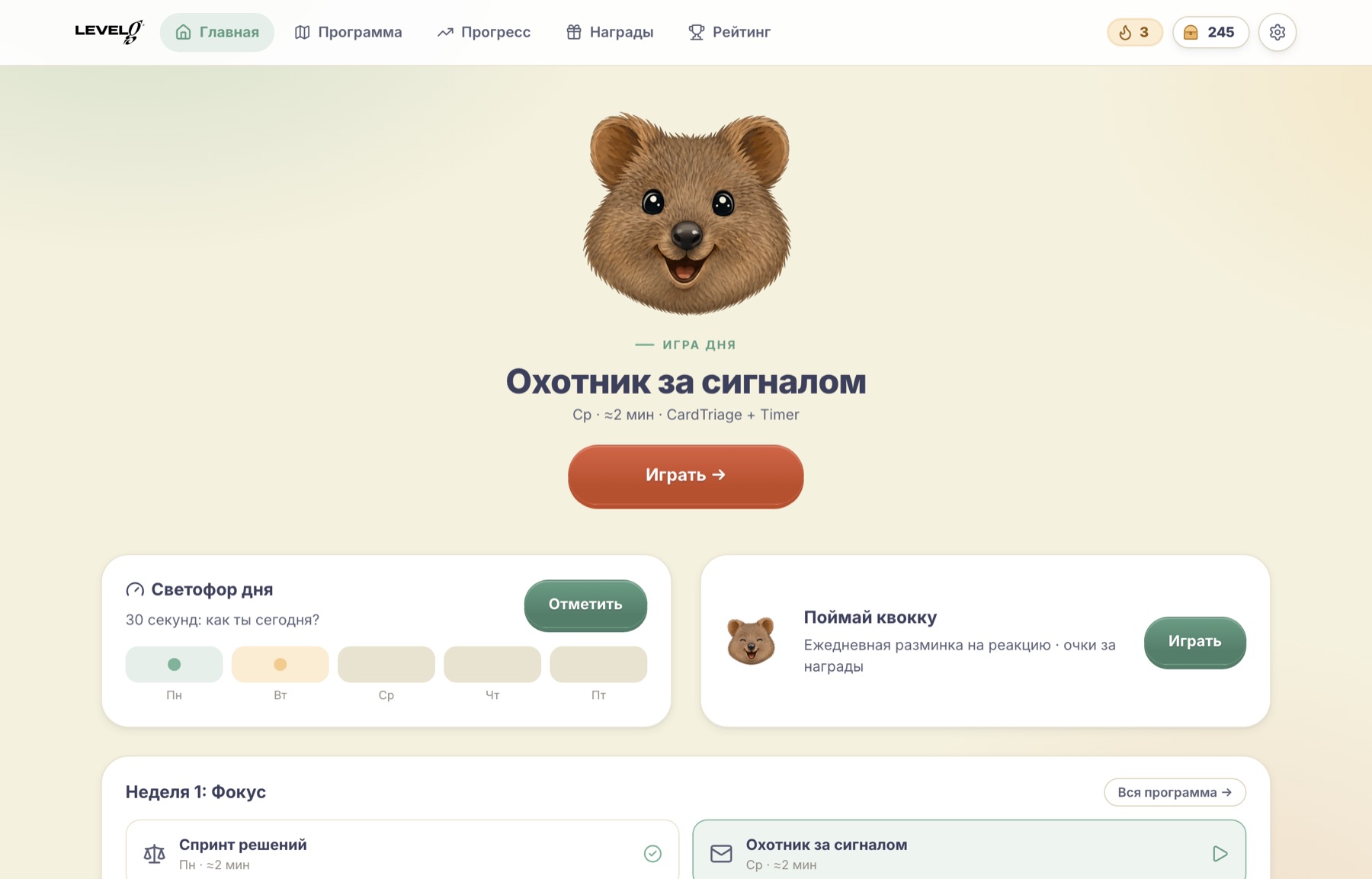
Two to three minutes. A real workplace situation with no obviously correct answer — an inbox to triage, a day to plan, a conversation to steer. The player is asked to act, not to rate themselves on a five-point scale.
The traffic light
Green, yellow or red, once a day, one minute. It exists so the platform has a signal on the days nobody plays, and so a run of red days can raise a flag before the monthly numbers would have.
The quokka
A mascot, not a mechanic. It reacts to how the week is going and it is the reason the app reads as care rather than as monitoring. There is no pet to keep alive and nothing dies if you skip a day.
Their own report
The player sees their own abilities and their own trend — the same seven clusters HR sees in aggregate, but for themselves alone. It is the honest exchange that makes the whole thing defensible.
Points that convert into something a person actually wants
Games and check-in streaks accumulate points. Once a month they convert: gift certificates from a catalogue of ten-plus brands, an extra day off, a remote day, lunch with the director, or the choice of topic for their next 1:1. All of it is inside the subscription — there is no separate rewards invoice.

Cognitive first, interpersonal later. The order is not decorative.
Four weeks, in this order.
Focus comes first because it is the least exposing thing to measure and the fastest to improve. Trust comes third because by then the player has a reason to believe the platform is not reporting on them. Ask about psychological safety in week one and you get the answer people think you want.
-
W1
Focus
Decision Sprint · Signal Hunter · Time Architect
Prioritisation, filtering, and planning around real energy. Feeds Decision-Making, Attention and Energy — three of the seven abilities are readable after week one alone.
-
W2
Stress-Balance
Control Circle · Red Flag Filter · Recovery Architect
Where effort is spent, when to escalate, and whether recovery is designed or improvised. This is the week that makes Burnout Risk a real number rather than an extrapolation.
-
W3
Trust
SBI Feedback Sprint · Difficult Conversation 360 · Can You Say This Out Loud?
Feedback quality, conflict navigation, and the willingness to raise something in the room. The Communication and Safety & Voice clusters both start here.
-
W4
Integration
Is It Safe to Say? · Go Look · Leadership Week · Assemble Team
Everything at once, under load. Leadership Week runs across five consecutive days and is what turns Succession Readiness from an estimate into a figure.
Not every company runs all four weeks. Configure a shorter package →
Thirteen games.
Five engines.
Every game is assembled from a small set of reusable engines, modifiers and flow containers, configured in YAML. That is why a new game takes days rather than a quarter — and why the scoring behaves identically across the catalogue.
Card Triage
Signal Hunter · Red Flag Filter · Control Circle
Sort a deck of items into buckets. Produces detection rates and false-positive rates.
Forced Selection
Decision Sprint · Can You Say This Out Loud? · Is It Safe to Say?
Choose one of several defensible options. Each option carries a type, and the pattern of types is the score.
Branching Dialogue
Difficult Conversation 360 · Sales Rep
A conversation that forks on every reply. Choices are typed blame / process / constructive / avoidant.
Free Text
SBI Feedback Sprint · Go Look
The player writes. A model reads it for structure, specificity and toxicity — the only place AI enters scoring.
Drag & Drop Builder
Time Architect · Recovery Architect
Assemble a plan from parts. Scored on placement against the player's own stated energy peak.
Timer overlay
A modifier, not an engine
Drops onto any engine. The gap between untimed and timed performance is itself a metric — Pressure Delta.
Five numbers, seven abilities underneath, twenty-five facts underneath that.
A dashboard you can drill all the way down.
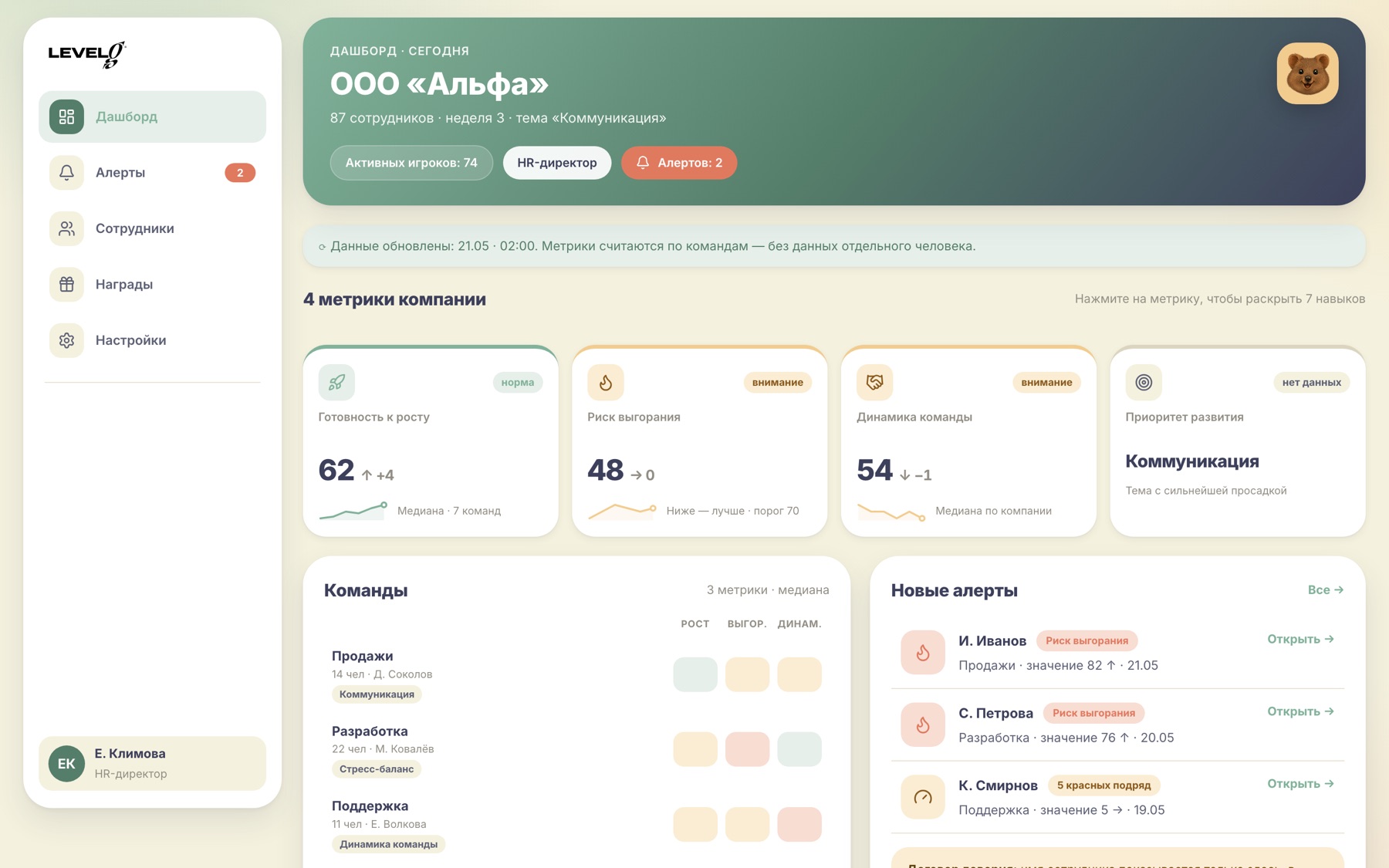
HR opens on five scores. Any one of them opens into the abilities that produced it, and any ability opens into the individual metrics and the games behind those. Nothing is a proprietary composite you have to trust on faith.
Team aggregates
Median, mean, spread and outliers per team — plus the sample size, so a team of four is never presented with the confidence of a team of forty.
Alerts in Telegram
Burnout Risk at or above 70, or five consecutive red check-ins. This is the only place a name is surfaced, and it is surfaced to one person.
Three benchmarks
Against the person's own history, against their team's median, and against the role profile. A score with no comparison is not information.
| Signal | Threshold | Who is notified | What is shown |
|---|---|---|---|
| Burnout Risk | ≥ 70 | The designated HR contact | Name, score, suggested 1:1 |
| Red streak | 5 consecutive days | The designated HR contact | Name, streak length |
| Team dip | −10 over 4 weeks | HR dashboard | Team only, no names |
| Ability spread | High variance | HR dashboard | Team only, outliers unnamed |
Everything outside the first two rows is an aggregate.
Live in days,
not a quarter.
There is no data warehouse to connect and no HRIS integration to schedule. The heaviest lift is deciding which teams form the first cohort.
Start the conversation- 01
Cohort and consent
You pick the teams. Each employee accepts a consent text before playing; the optional second consent governs the deeper personal indicators and can be declined without losing access to the games.
- 02
Invitations
Email invitations with single-use links, or the Telegram bot. No password to distribute, no seat provisioning spreadsheet.
- 03
Onboarding questionnaire
Ninety seconds. Role, team, and the player's own energy peak — the last one is what Time Architect scores against, so it is asked rather than assumed.
- 04
Week one
Three games plus daily check-ins. By the end of it, three of the seven abilities are populated and the first provisional Burnout Risk appears.
- 05
Month one review
The first trend worth acting on, walked through together. This is also where most companies widen or narrow the game package for the next cohort.
See it running on your own team's scenario.
Fifteen minutes, the real product, your teams' shapes and sizes — not a slide deck.