Every game is a workplace situation with no obviously right answer. The score comes from
what the player does inside it — which option they take, where they put the hard task,
whether they name a process or a person — never from a self-assessment.
Each entry below says what the game puts the player through and which ability cluster it
feeds. If a game is not in your package, the facts behind it are not collected, and the
cluster above it stays incomplete.
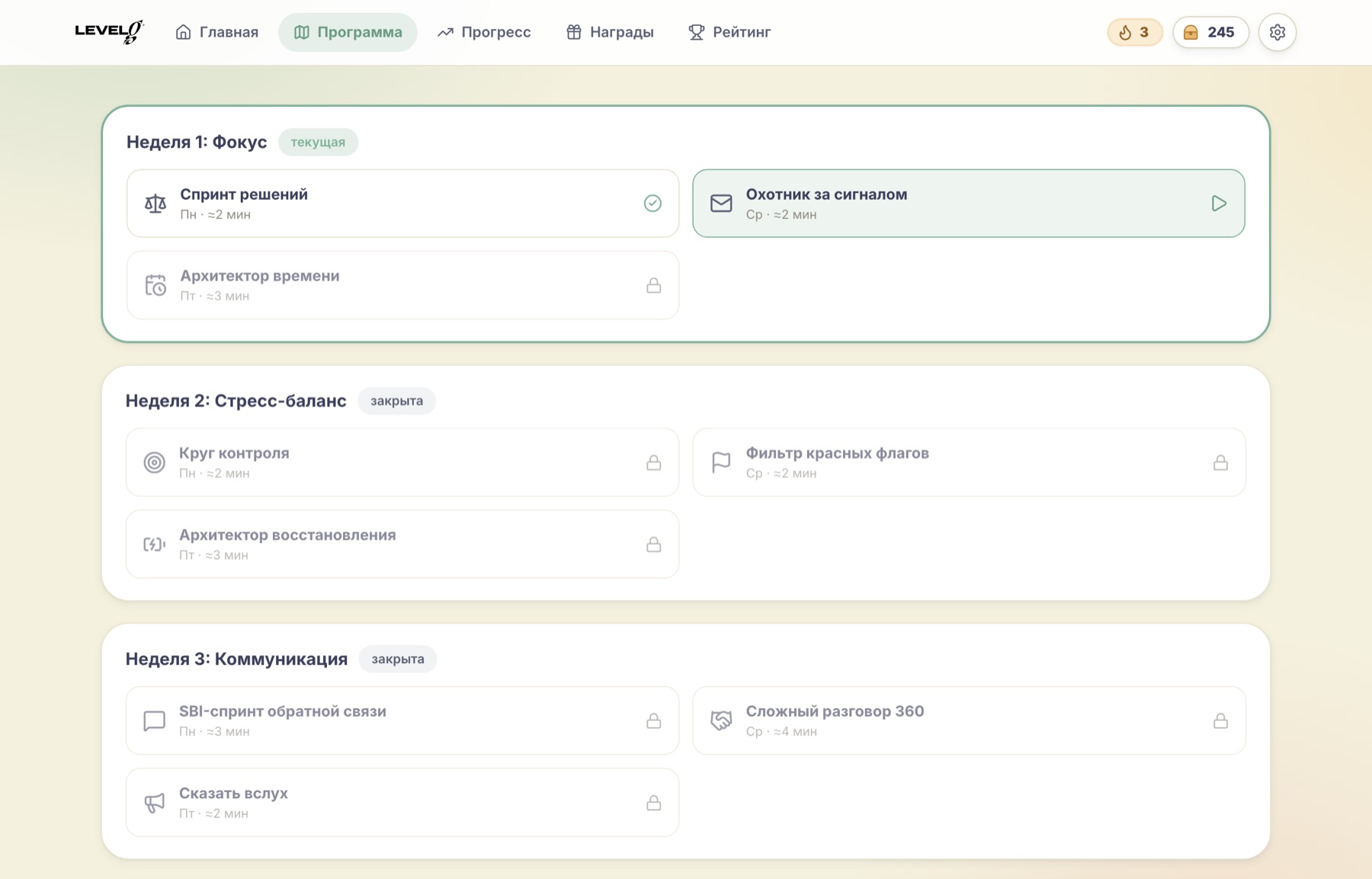
The catalogue as the player meets itFour weeks, three games each (four in the last), with done, current and locked states. Everything below on this page is what sits behind one of those rows.
Outside the weekly budget. One minute, no scoring.
Traffic Light Check-in
Self check-in · available every day · 1 min
No scored metricFeeds the alert
Green, yellow or red. Not a skill test — the heartbeat underneath everything else, and
the only input that is available on days nobody plays a game.
Why it matters commercially: five consecutive reds is one of
the two conditions that raises a named alert. Skip the check-in and the platform can only
see you weekly.
W1Focus
Prioritisation, filtering, planning. The least exposing week, and the usual pilot.
Decision Sprint
Forced Selection + Free Text · Timer 90s · 3 min
Decision-MakingAI-scored
Ten rounds of competing tasks. The first five are calm; the last five are timed. The gap
between the two halves is the measurement — plenty of people decide well until the clock
starts.
Signal Hunter
Card Triage · Timer 45s · 2 min
Attention
An inbox where some messages are genuinely urgent and some are only dressed that way.
Sorting them under time pressure shows how much manufactured urgency gets through — the
single best early predictor of a fragmented week.
Time Architect
Drag & Drop Builder · 3 min
EnergyAttention
Build tomorrow out of a pile of tasks. Scoring is against the player's own energy peak,
taken from onboarding — so the same schedule is a good answer for a morning person and
a poor one for someone who comes alive at four.
W2Stress-Balance
The week that turns Burnout Risk from an extrapolation into a number.
Control Circle
Card Triage + Forced Selection · 2 min
Stress Response
Sort what you can influence from what you cannot. Built on Covey's circles. Trying to
control the uncontrollable is one of the earliest and most reliable burnout tells —
above 60% and the correlation is strong enough to act on.
Red Flag Filter
Card Triage · 3 min
Stress ResponseCustomisable
Twelve situations, one question each: does this go up the chain now, later, or never?
Escalation is cultural, so the reference answers ship as a sensible default set and can
be rewritten with your HR team on the Scale tier.
Recovery Architect
Drag & Drop Builder · 3 min
Energy
Six load points across a week. At each one the player picks a sustainable move — a
pause, a walk, ten minutes without notifications — or a heroic one: push on, another
coffee, one more call. Heroic works once and compounds badly.
W3Trust
Asked in week three, not week one — by then the player has reason to answer honestly.
SBI Feedback Sprint
Free Text · AI scoring · 4 min
CommunicationAI-scored
Five scenarios, five pieces of written feedback, judged against the
Situation–Behaviour–Impact model. A model reads each one for whether there is a concrete
situation, a concrete behaviour rather than a character verdict, and a stated
consequence — plus a separate toxicity read.
Difficult Conversation 360
Branching Dialogue · 4 min
CommunicationSafety & Voice
Three branching conversations that get harder as they go. Every reply is typed —
blame, process, constructive, avoidant — and the distribution across all three
dialogues is the result. One blaming reply is a bad day; a pattern is a finding.
Can You Say This Out Loud?
Forced Selection · 2 min
Safety & Voice
Situations where something needs saying. Say it plainly, say it carefully, stay quiet,
or raise it later. The split between speaking and staying silent tells you more about
the room than about the person.
W4Integration
Everything at once, under load. This is where Succession Readiness stops being an estimate.
Is It Safe to Say?
Forced Selection + Conditional Flow · 3 min
Safety & Voice
Colleagues raise things; the player reacts eight times — support, probe, dismiss,
ignore. The game then tracks whether those colleagues go on to say more or less. It is
the difference between claiming to want candour and producing it.
Go Look
Forced Selection + Free Text · 3 min
Systems & LeadershipSafety & Voice
Something went wrong. Each investigative step heads either toward the system or toward
a name, and the game ends on a forced verdict: the process, or the person. Modelled on
Toyota's genchi genbutsu — go and see for yourself.
Leadership Week
Multi-day scenario · five consecutive days · 3 min each
Systems & LeadershipStress ResponseCommunication
Five consecutive days as the person in charge. Consistency across the five is the whole
point — one excellent Monday proves nothing, and the standard deviation across the days
is literally the formula. It is the single densest game in the catalogue.
Assemble Team in 90 Seconds
Forced Selection · Timer 90s · 2 min
No scored metric yetEngagement
A crisis, a bench of people with different strengths, ninety seconds to pick a crew.
It is in the programme for engagement and cohesion, and it does not feed a scored
metric — which is stated here rather than quietly implied, because a game that looks
like measurement but isn't is exactly how trust gets lost.
Not in the current release
What is next and what was cut.
Specifications exist for these and they are valid. They are out of the current scope,
and we would rather say so on the catalogue page than in a footnote after signature.
Compliment Letter
Deferred to a later release
Peer recognition, written. Deferred because peer-to-peer mechanics need a moderation story before they ship, not after.
Pattern Command
Cut
Cut from Week 1 for duplicating Decision Sprint — two games producing the same signal is cost without information.
Broadcast Together
Requires multiplayer architecture
Real-time team synchronisation. It needs a separate session model, which is a platform project rather than a game.
1:1 Without Drama · Partner Scene · Remove One Stone
Specified, not scheduled
Written, mapped to existing engines, and available to prioritise if they match what your data turns out to say.
Which of these do you actually need?
The configurator answers that in about ninety seconds, with the real scoring maths behind it.